I was decluttering some stuff in my father’s house a while ago and found my childhood journal. It was a little pink notebook with a lock on it. It was only half-filled, and entries were sometimes months apart, as, like now, journaling was something I would only do when I had something important to say—like registering a major event.
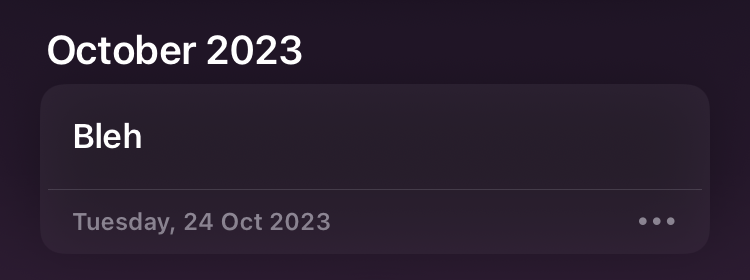
So, it makes sense that when I tried to start journaling as an adult, I had the same problem. I would write for a couple of days, usually starting when something different had happened, and then I would try to keep going for a few more days. But eventually, I’d just stare at the page with nothing to say, so much so that some entries in my current digital journal contain only the word “Bleh.” Really.
I thought having some prompts would help. I went around the Internet and compiled some, but I realized that when you create prompts for yourself, they are based on your self-knowledge and what you want to write about. So when you make them available, they don’t resonate the same way with others. I want the act of journaling to feel natural, like I’m letting out stuff from inside me—not to be a creative exercise in writing, where I have to forcefully come up with something to say.
I had a second issue, easier to solve once identified. I would hold back while writing, fearing that someone might read it someday. I don’t know, maybe I could just drop dead at any time and leave behind a bunch of embarrassing things, as well as things people close to me don’t need to know—like raw, unprocessed emotions. I use my journal like a drawing board, helping me better organize and express my feelings.
I’ve recently read An Emotional Education from the School of Life, which I’ve been following for several years. I’ve been a fan of Alain de Botton’s work since Status Anxiety in the early 2000s. It’s a book I strongly recommend—not phenomenal, but with phenomenal passages, where complicated things are very clearly explained.
I mention the book because it has a section on the markers of emotional health, and it asks:
Can we patiently and reasonably put our disappointments into words that, more or less, enable others to see our point? Or do we internalize pain, act it out symbolically, or discharge it with counterproductive rage?
I discovered that, for me, the answer was “No.” and “Yes.” I finally came to understand that a way to work on that would be to journal—write, write, write—and rehearse different ways to look at things until one made sense and was clear enough to be put out there. My family won’t gain anything from knowing the mess in my head. It’s like, you clean the house before guests arrive, right?
Now, on to the solutions:
The second problem was easier to solve by experimenting with different mediums. I discovered that what works for me is the iPhone Journal app, where you need to authenticate even if the phone is unlocked. For me, it was gold—I can use it at will, and my son can even play with the phone while keeping my journal out of the way.
This is very practical when I don’t have much time. But I also found that I prefer writing on a physical keyboard rather than a touchscreen, so sometimes I write on my computer. You can use apps, password-encrypted files, or even write emails to an address you never check, etc. I like to keep it out of my Drive, because this will be passed on to my husband by Google if something happens to me. He knows my head is a mess, but he’s not ready for a whole other level of mess like the one in my journal.
The prompting problem:
I kept using the journal whenever I felt I had to immediately get something off my chest, even if the timing wasn’t appropriate or I wasn’t really sure what the issue was. But I also created a prompting box. The box wasn’t made of written prompts. Instead, it was made of sentimental items I had kept over the years—things that wouldn’t make sense to keep, since I was the only one for whom they were sentimental. Ticket stubs, little notes or gifts, postcards from places, etc.
Whenever I didn’t know where to start, I would pick up one of the items, take a picture, and write about it—the reasons I kept it, and why I felt I could let go of it. So, simultaneously, I was letting go of physical and emotional baggage. I have to say, this was life-changing. I now write with pleasure, and this great habit is reinforced by the amazing feeling of letting go of the responsibility toward those items—and the lightheartedness that comes from finally integrating those experiences into my sense of self.
 The technology humanist
Leave a comment